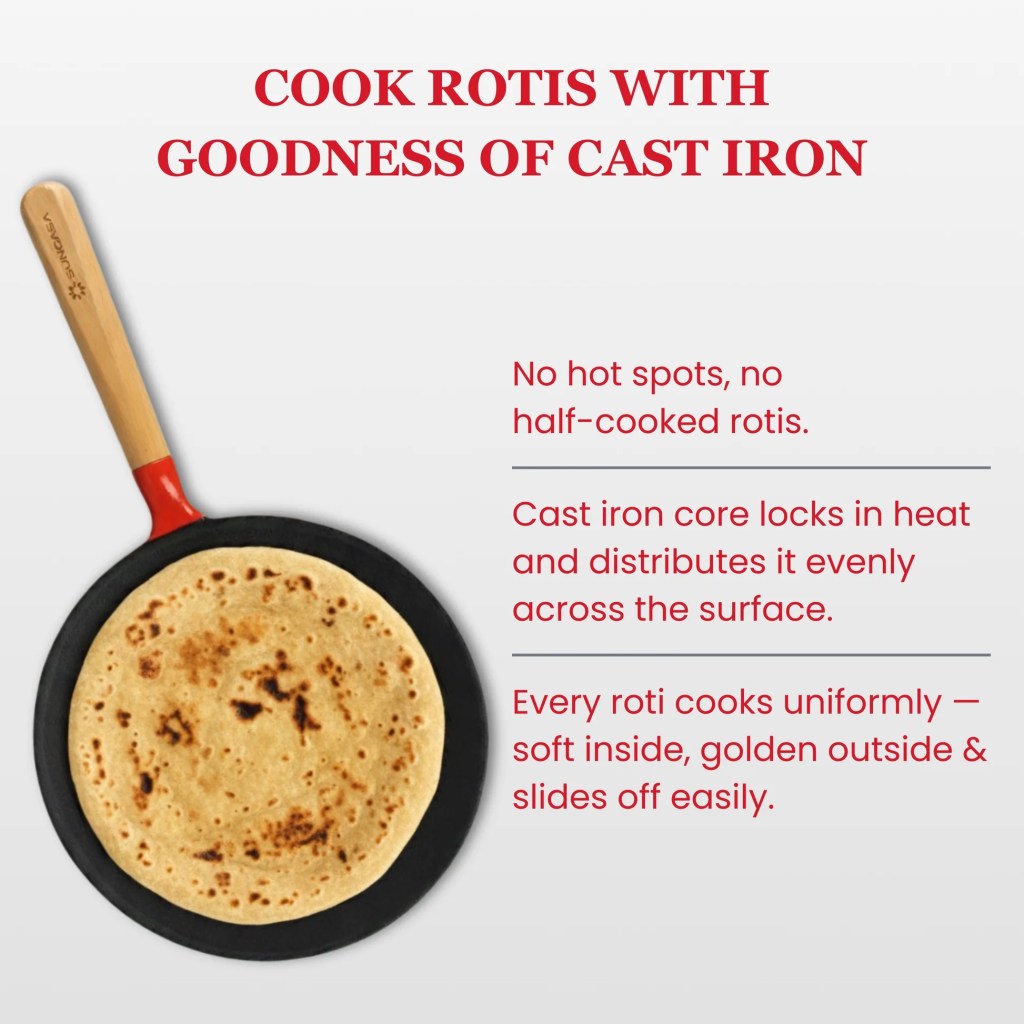
If you have recently switched to an induction stovetop, you have likely encountered the most frustrating hurdle of modern Indian cooking: turning out perfectly soft, puffed rotis. For many, the first few attempts result in hard, chewy papads or unevenly cooked flatbreads, leading to the myth that you simply cannot make good rotis without an open gas flame.
You absolutely can make perfect, puffed rotis on an induction stove. The secret is swapping your thin non-stick pan with a heavy cast-iron tawa for roti and pre-heating it at a high wattage (1200W+) to trap the steam inside the dough before it dries out.
Here is the exact science, the non-negotiable cookware, and the step-by-step methods to master the induction roti.
Why Rotis Fail on Induction (The Physics)
Understanding why your rotis are failing is the first step to fixing them. It comes down to how heat is transferred.
A gas stove provides continuous, ambient heat that wraps around the pan. An induction stove provides direct, magnetic contact heat only to the base of the cookware.
When you place cold dough onto a thin tawa on an induction stove, the temperature of the metal drops instantly. The induction sensor takes a few crucial seconds to register the drop and push more power. During that lag, your roti is sitting on a lukewarm surface, losing its internal moisture. By the time the pan heats back up, the roti is too dry to puff, resulting in a hard, cracker-like texture.
The Non-Negotiable Gear: Choosing Your Tawa
To fix the temperature drop, you need to change your cookware.
Cast Iron vs. Non-Stick
You must ditch the lightweight aluminum tawas. When comparing cast iron vs. non-stick, a heavy cast-iron tawa is mandatory for induction rotis. Cast iron has immense thermal mass; it absorbs and retains heat beautifully. When you put cold dough on a pre-heated cast-iron tawa, the temperature does not drop. It perfectly mimics the sustained, aggressive heat of a gas flame.
The Flat-Bottom Rule
Traditional concave (curved) tawas will not work. Induction relies on a magnetic field. If the center of your tawa lifts even a millimeter off the glass surface, the connection breaks, and the stove will beep or shut off. Ensure your cast-iron tawa has a completely flat, machined base.
The “Cloth Press” Method (The Most Reliable Technique)
This is the most consistent method for getting a perfect puff without needing an open flame or extra equipment.
Time Required: 5 Minutes
Tools Needed: Flat-bottom cast-iron tawa, a clean folded kitchen towel.
Step 1: The High-Heat Pre-Warm
Place your cast-iron tawa on the induction stove. Set the power to 1200W (or Medium-High) and let it preheat dry for 3 to 4 minutes. The pan must be radiating heat before the dough touches it.
Step 2: The First Cook (Base Layer)
Place the rolled roti on the tawa. Keep the setting at 1200W. Wait exactly 10 to 15 seconds until you see tiny bubbles forming on the surface. Flip it immediately.
Step 3: The Second Cook (Bottom Layer)
Let the second side cook for about 20 to 30 seconds until brown spots appear on the underside.
Step 4: The Press and Puff
Flip the roti one last time (back to the first side). Take your folded kitchen towel and gently press down on the edges of the roti. This pressure traps the steam inside the dough, forcing it to separate the layers and puff up entirely on the flat surface. Remove immediately and brush with ghee.
The Gas-to-Induction Translation Guide for Flatbreads
Stop guessing what “medium flame” means on your digital display. Use this matrix for perfectly staged heating.
| Cooking Stage | Gas Stove Equivalent | Induction Setting (Wattage) |
| Pre-heating the Tawa | High Flame (3 mins) | 1200W – 1400W |
| Cooking Side 1 & 2 | Medium-High Flame | 1000W – 1200W |
| The Final Puff | High Flame | 1400W |
| Paratha (Frying in Ghee) | Medium Flame | 800W (To prevent smoking) |
Troubleshooting Common Roti Disasters
Why are my rotis hard and chewy on the induction stove?
Your rotis are getting hard because the heat setting is too low or your tawa is too thin. Moisture is evaporating before the steam can build up. Increase your wattage to at least 1200W and use a heavy cast-iron pan to retain the heat.
Why does my induction stove keep beeping when I make rotis?
The stove beeps because the magnetic connection is breaking. This happens if your tawa has a curved bottom, or if you are physically lifting the pan off the glass to flip the roti. Keep the pan perfectly flat and use tongs or a spatula to flip the bread.
Why is the roti burning on the outside but raw inside?
You have set the induction wattage too high (1800W+). Because induction heats the metal directly and instantly, a maximum setting will scorch the flour on contact before the heat penetrates the dough. Drop the setting to 1200W.


Leave a Reply